Confused between Quranic Arabic and Spoken Arabic? Learn the key differences, pros and cons, and discover which type of Arabic is right for your goals - whether for religion, travel, everyday conversation, reading, or business . The type of Arabic you choose will sharp your learning experience.
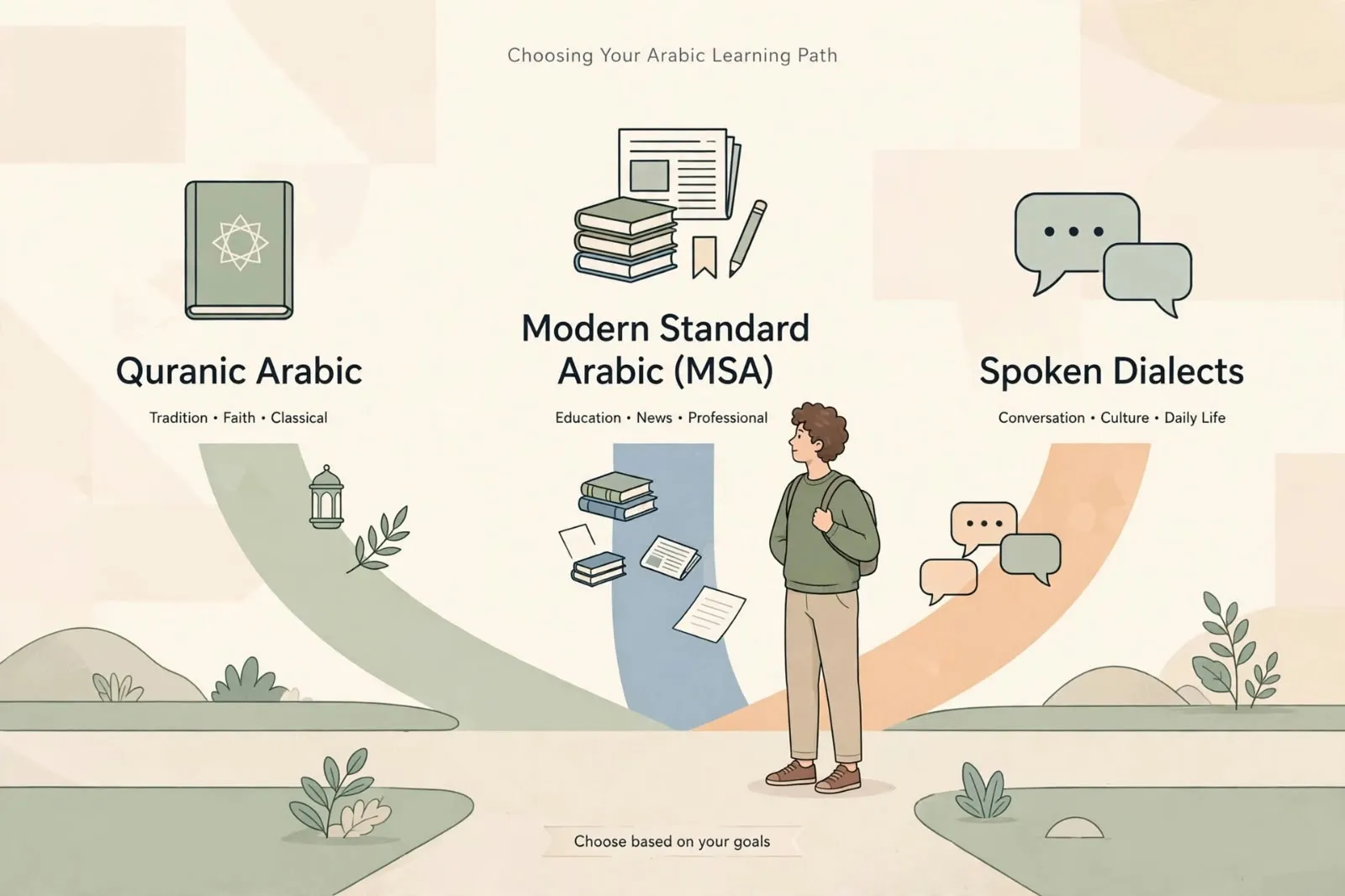
For many learners, the choice comes down to two main paths: Quranic Arabic, which includes Classical and Modern Standard Arabic, and Spoken Arabic, which refers to the daily dialects used across the Arab world.
Understanding the purpose of each can help you make a decision that matches your personal goals.
WHAT IS QURANIC ARABIC?
Quranic Arabic is the language of the Quran, Hadith, and classical Islamic literature. Modern Standard Arabic, or MSA, is its modern form and is used today in books, news broadcasts, official documents, and formal education.
It is the form of Arabic that is understood in writing and in formal settings across all Arab countries.
This path may be suitable if your main interest is in reading and understanding religious texts, studying Islamic sciences, or accessing formal Arabic literature. It also provides a strong grammatical foundation, which makes it easier to learn other forms of Arabic later.
WHAT IS THE SPOKEN ARABIC?
Spoken Arabic refers to the colloquial dialects that people use in daily life. These dialects vary by region and are used for conversation with family, friends, colleagues, and in everyday situations such as shopping or traveling.
Common examples include Gulf Arabic used in Saudi Arabia and the UAE, Egyptian Arabic which is widely understood due to media, Levantine Arabic used in Jordan and Lebanon, and Darija used in North Africa.
This path may be suitable if you plan to live in, travel to, or work with people from a specific Arab region. It allows you to build rapport, participate in everyday conversations, and understand local culture more directly.
How to Choose Based on Your Goal?
Instead of asking which form is better, it is more useful to ask what you want to use Arabic for.
Begin with your main point: your reason for learning Arabic.
If your goal is to understand the Quran, read classical texts, or develop formal literacy, starting with Quranic and MSA Arabic provides a strong and lasting base.
If your goal is to communicate in daily life, build professional relationships, or feel comfortable in a specific country, starting with the relevant spoken dialect will give you more immediate results.
For many learners, a combined approach works well. A foundation in MSA helps you understand the structure and roots of the language, while learning a spoken dialect helps you apply it in conversation.
A Daily Learning Exercise
Set aside ten minutes to clarify your direction.
1. Choose one goal for learning Arabic, such as understanding a verse, introducing yourself, or conducting a short business exchange.
2. Write three keywords related to that goal.
3. Speak for one minute about why that goal is important to you.
4. Record yourself if you feel comfortable.
5. Listen once and identify one part that was clear.
6. Choose one small improvement for tomorrow.
This exercise helps you connect your learning choice to a practical purpose, rather than trying to learn everything at once.
Handling the Confusion Between Forms
When you encounter an unfamiliar word, consider its context. Is it used in a formal text or in a casual conversation? If you are unsure, note the expression and ask your teacher how it is used in different settings.
You can use helpful phrases such as:
- "Is this word used in MSA or in spoken dialect?"
- "How would you say this in everyday conversation?"
- "Could you explain the difference between these two forms?"
These questions turn moments of confusion into focused learning tasks.
Frequently Asked Questions
Can I learn both at the same time?
It is possible to understand both, but it is often more manageable to build a foundation in one form first and then add the second gradually. A teacher can help you decide on a suitable order.
Do I need to be perfect in grammar before speaking?
You can practise clear communication at any level. Start with short, purposeful sentences and expand as your vocabulary grows.
How can a teacher help me choose?
A teacher can assess your goals, recommend suitable materials, and provide structured practice. At Afra Linguistic Academy, learners can explore Arabic education alongside communication skills and public speaking programs.
Take Your First Step
Choose one reason why you want to learn Arabic today. State it simply, give an example of how you would use it, and share it with a teacher or learning partner. A clear purpose makes your learning more focused and sustainable.
Explore our Arabic Programs to find a learning path that matches your goals.
Frequently Asked Questions
What is the main difference between Quranic Arabic and Spoken Arabic?
Quranic Arabic (Classical/MSA) is used for the Quranic, formal writing, and news and is understood across the Arab world. Spoken Arabic is the daily colloquial language used for conversation and varies by country.
Which Arabic helps you find your voice faster?
Quranic Arabic helps you find depth and meaning through literature and formal texts. Spoken Arabic helps you find fluency and connection in everyday conversations. The best choice depends on whether your goal is understanding texts or speaking with people.
Should I learn Quranic Arabic or Spoken Arabic for confidence?
Confidence comes from clarity, not perfection. Start with the form that matches your immediate goal - Quranic for reading and spiritual connection, Spoken for daily interaction - and use simple structures to express one idea at a time.
Learn With Afra
Arabic Language Program
Turn what you’ve read into real progress with structured, personal teaching — live online or in Karachi.